 KIRAN GOES PLACES
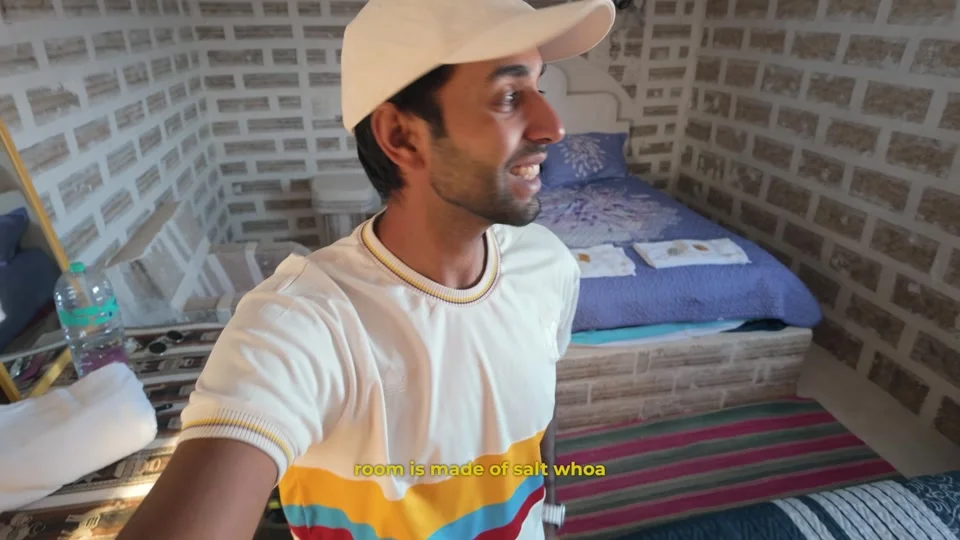
Getting here was an adventure in itself. We'd crossed from Chile into Bolivia a couple of days before, had breakfast by the roadside, stopped at lagoons full of flamingos, spotted a rock shaped like a camel, and sipped coca tea for the altitude headaches. Two days in, we stayed the night at a hotel built entirely from salt on the edge of the Salar de Uyuni. That was already one of the strangest nights of the trip, but the actual reason everyone comes out here was still ahead of us. Sunrise, when the whole desert turns into a mirror.
A 5am start and a jeep onto the flats in the dark
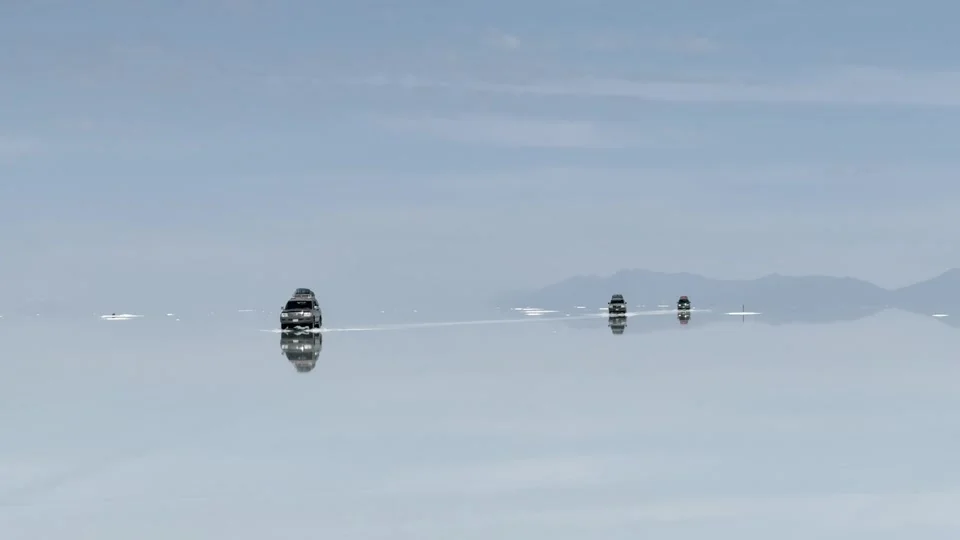
We woke up while it was still properly dark, 5am, and piled into a jeep with our guide Geo and four strangers who by that point felt more like friends. Two days of this trip already down, everyone tired but genuinely buzzing to finally see the thing we'd been driving towards. In the wet season, rainwater comes down off the Andes and spreads out across the salt crust in a sheet only a few centimetres deep. The ground is so flat that it just can't drain, so it sits there and turns the entire desert into a mirror. We drove out in the pitch dark through a foot of water, headlights barely picking out anything beyond the glass-flat surface in front of us.
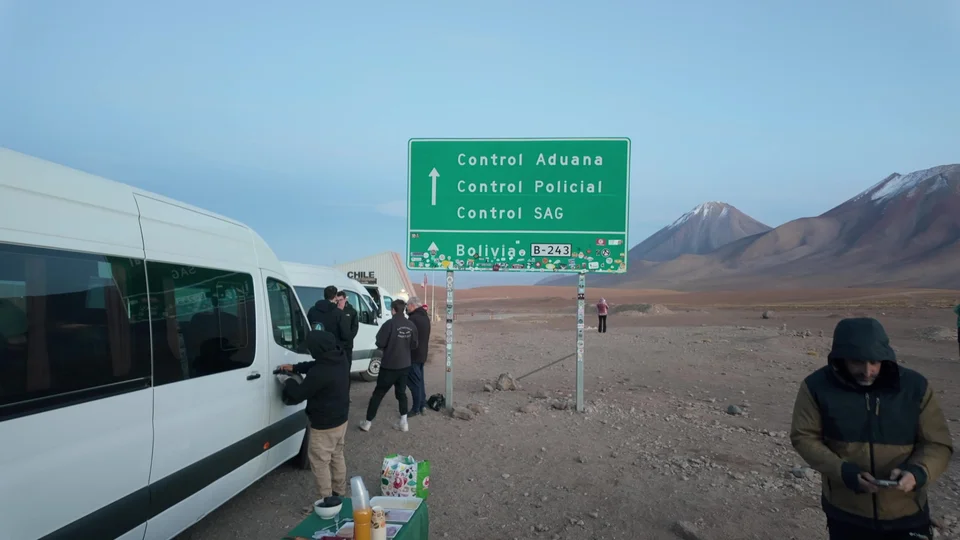
The journey out here, through border crossings, lagoons and flamingo colonies.
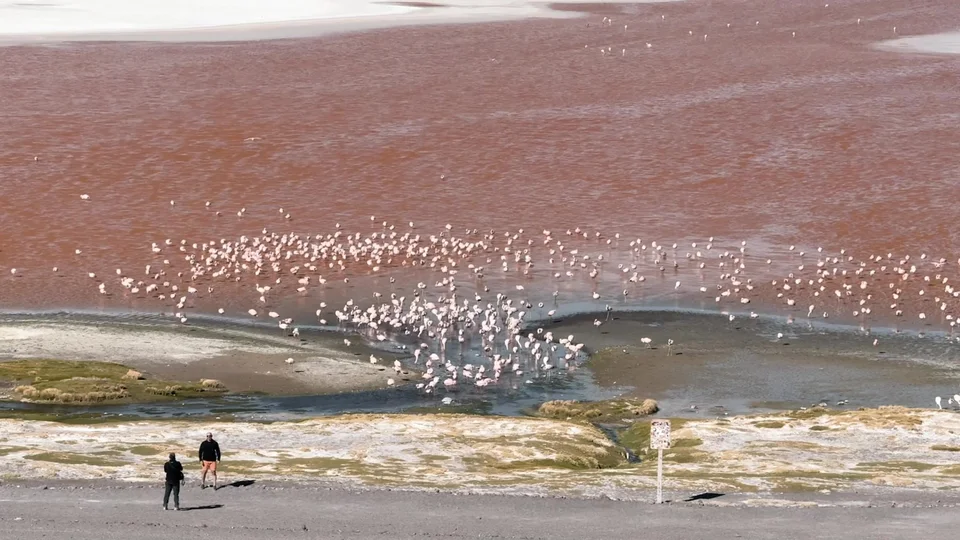
One of the flamingo lagoons we passed en route.
Eventually we stopped in the middle of what genuinely felt like nowhere. Got out, and we'd been handed Wellington boots beforehand, which made a lot more sense once we were wading through actual standing water. Walking through it in the dark, looking down and seeing the stars reflected under our feet as well as above us, was one of those moments that's hard to describe properly. This was our spot.
Sunrise on the world's biggest mirror
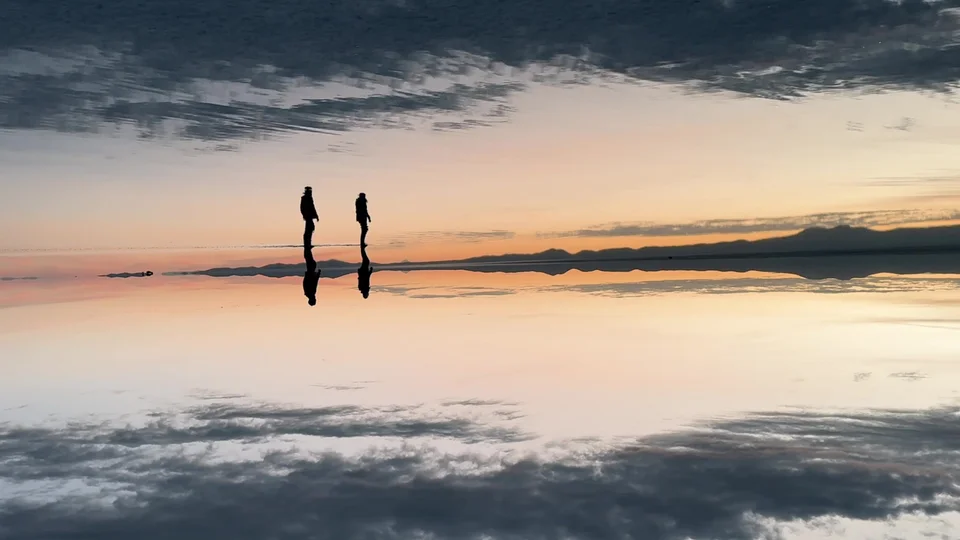
As the sun came up it was unlike anything I've seen. In the low light you genuinely can't tell where the water ends and the sky begins, everything just blurs into one. Then as the sun climbed higher it reflected perfectly across the water and turned the whole scene orange. Geo, our guide, said it reminded him of that scene in Bruce Almighty where the world feels infinite, and you half expect Morgan Freeman to just appear somewhere out on the horizon. Honestly, that's about the only way to describe it.
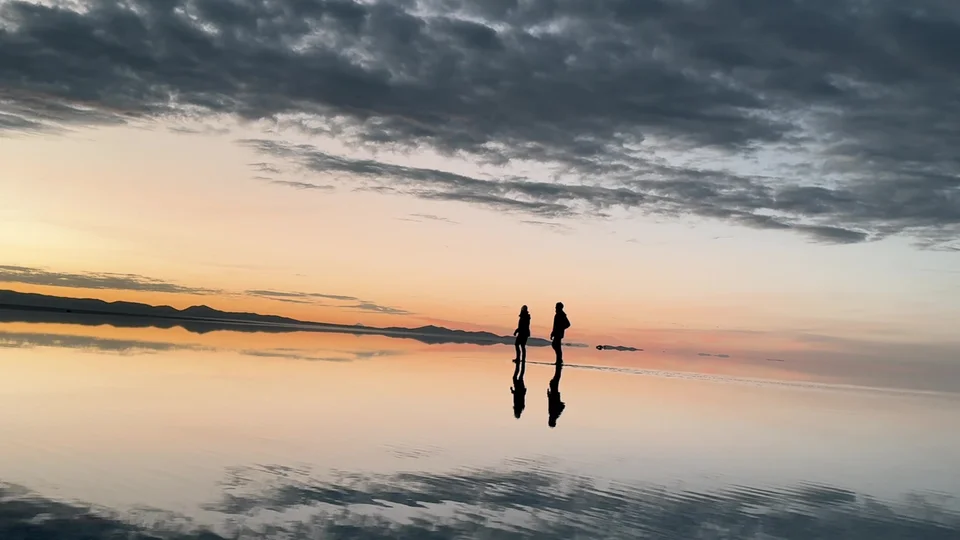
No landmarks, no shadows, just sky and its reflection.
Once the sun was properly up, Geo turned out to be a wizard with perspective shots too, lining everyone up and driving around to get some completely ridiculous, otherworldly photos and video out of us.
Breakfast at a second hotel made of salt
From there we drove further into the flats towards a circular restaurant that felt like it had been dropped into the middle of nowhere. The Salar de Uyuni is colossal, something like 10,500 square kilometres, bigger than Jamaica or Lebanon, so flat and vast that NASA actually uses it to calibrate satellites. Driving across it genuinely feels like skating over a frozen ocean. This restaurant turned out to be, unsurprisingly, another hotel made completely from salt, decked out with Andean touches everywhere, including a very good llama with little pom poms on it. We had cereal, coffee and cake to celebrate the last day of this leg of the trip.
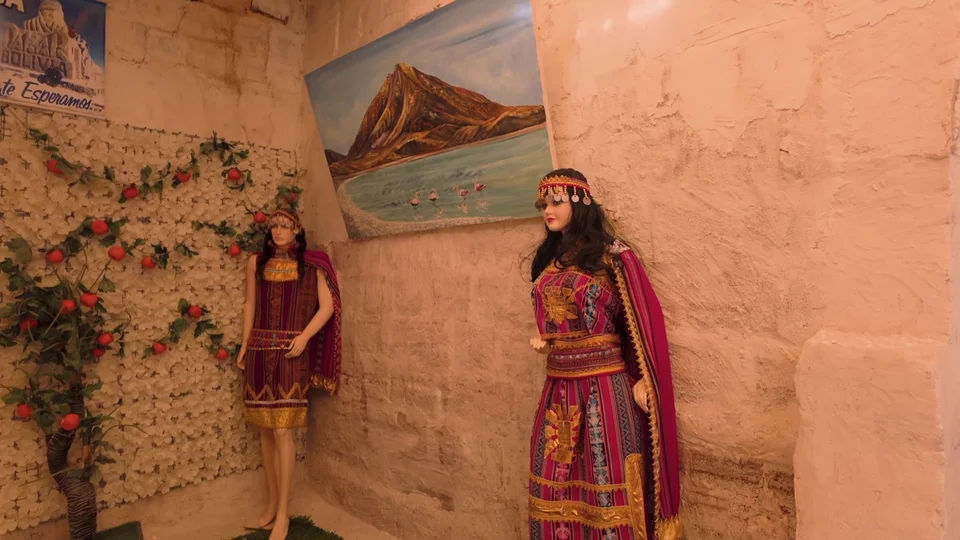
Breakfast stop, also built entirely from salt.
Just outside is the famous Plaza de Banderas, a proper splash of colour in all that white. Travellers from all over the world leave their national flags here, so it's basically turned into a giant international guestbook in the middle of a salt desert. Someone had brought a Frisbee, and I'm fairly confident this is the most surreal place I've ever seen one thrown.
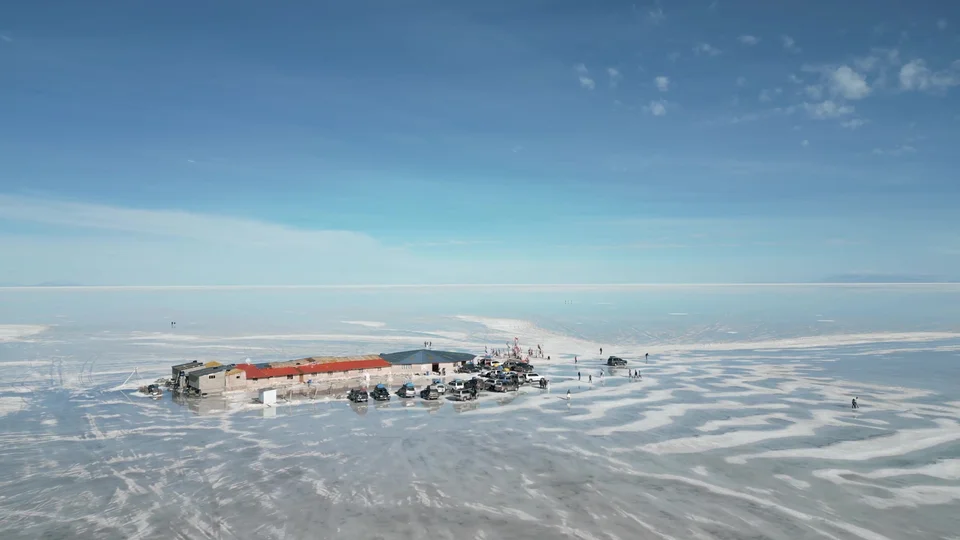
The restaurant complex and Plaza de Banderas from above.
The forced perspective shots everyone comes here for
The flats are perfect for perspective photos because there's nothing else around to give you a sense of scale, no landmarks, no shadows, nothing. Something close to the camera reads as exactly the same size as something far away, so you can build a giant dinosaur, a tiny human, whatever you like. Geo was completely in his element setting these up, at one point lying face first in wet salt just to line up the perfect shot.
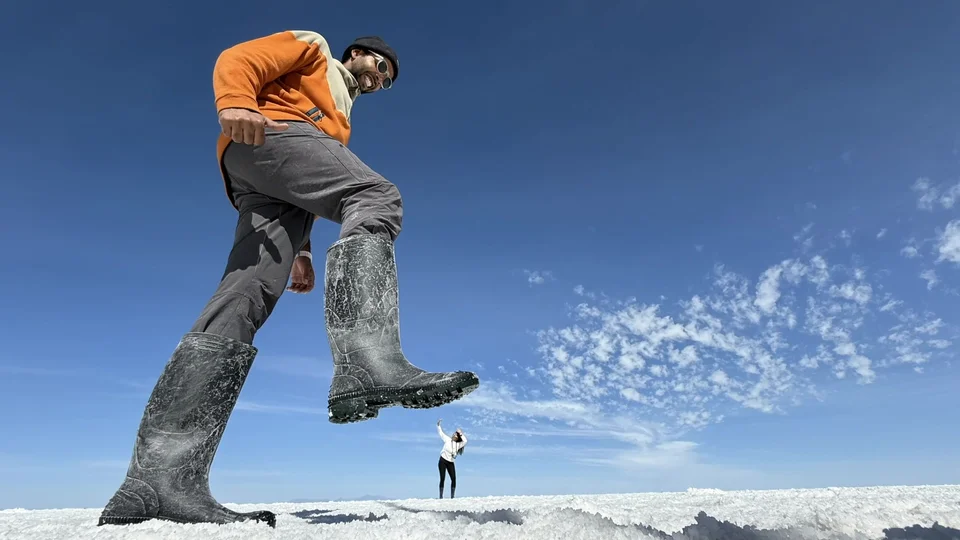
No landmarks means no sense of scale, which makes for some ridiculous photos.
Leaving the mirror behind
Even a local bus went gliding across the flats at one point, connecting some of the nearby towns, which felt like a strange thing to witness out here. Kind of didn't want to leave, it's genuinely one of the most beautiful places I've been. But all too soon it was time to head off the flats and keep moving, deeper into Bolivia, towards more indigenous communities, more culture, and eventually the mountains of Peru.
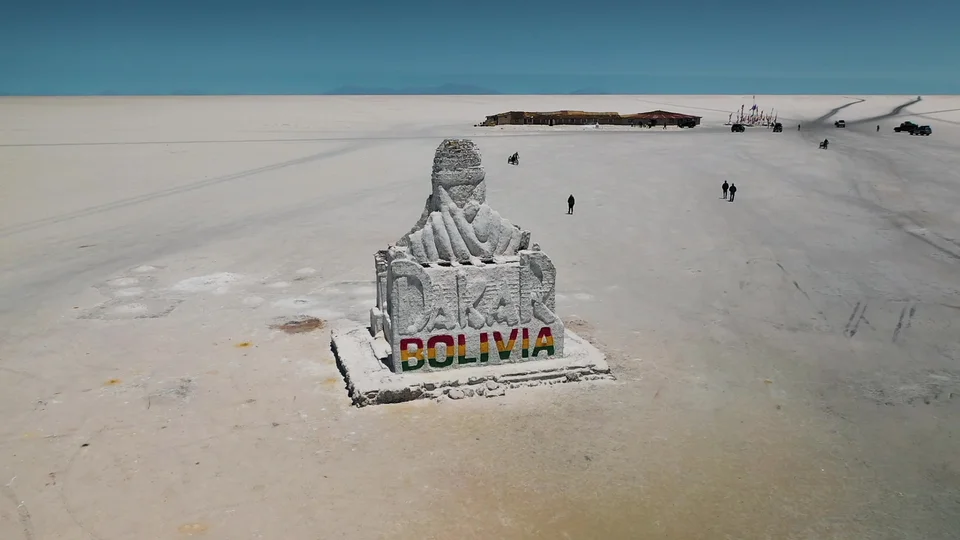
One last landmark before leaving the flats behind.
If you're planning your own trip out here, I've written up everything worth knowing before you visit the Uyuni Salt Flats, and what it's actually like to sleep in a hotel built entirely from salt.